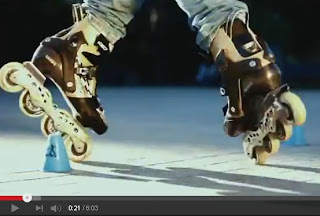
Типът спиране с ролери до голяма степен зависи от скоростта. За начинаещите е достатъчно да завият с троп, троп, троп и са спряли. Но с увеличаване на скоростта трябва да започнете да учите различни видове спиране с ролери, както и слайдове.
Школата по ролери в Бургас тренираме всеки ден в Морската градина. Желаещите може да се запишат за месечни или индивидуални уроци по ролери. Но първо се обадете да си купите добри ролери за тренировки: тел. 0878197022
2. Този вид стоп може да прерастне в Хокей-стоп или Пауър-слайд
ХОКЕЙ-СТОП
ПАУЪР-СЛАЙД
3. Или във Спин-стоп
4. Начални стъпки в спирането с ролери
Но като начало трябва да започнете с т.н. "Рало". Разтварате краката и събирате коленете, като бутате на страни. Това трябва да ви спре. Но разбира се, това не е практично за големи скорости. Другия стоп, който ще видите в това видео е "Т-стопа".
Тренировки по Ролери Бургас - Морската градина
Уроци по ролери - Бургас в Морската градина до знамената. Всеки ден при слънце се събираме в Морската градина да караме ролери. Уроците са за всички възрасти; за начинаещи и напреднали. Бургас е прекрасно място за каране на ролери.
Дори тези зимни дни излизаме в парка когато е слънце и сухо. Особенно в събота и неделя има доста ролеристи в Морската градина още от обяд. Уроците по ролери са си истински адреналин.
Трябва да се направи Семинар по фристайл слалом в Бургас. Семинар по фристайл слалом за деца и за възрастни.· Да караме заедно ролери в Бургас... Тренировки всяка вечер. Тел. 0878197022
Slalom Tricks: Mega snake, Mega cross, Trivolte, Mabvar C Български слалом трикове с ролери
Клипът е заснет по време на сбирката на фейсбук групата "Да караме заедно ролери!" в спортния център на парк "Свобода" в град Пазарджик.
Дори тези зимни дни излизаме в парка когато е слънце и сухо. Особенно в събота и неделя има доста ролеристи в Морската градина още от обяд. Уроците по ролери са си истински адреналин и стават за всички възрасти. Най-малките са от 4 годишни, а най-възрастните над 70 годишни.
Бургас: Всеки ден тренираме в Морската градина до знамената - боди-билдинг уредите. Общите уроци са всяка вечер от 18:30. За желаещите може и индивидуални уроци.
Artist: Yummy Bingham (Feat. Jadakiss) Song: Come Get It
Lyrics:
Uh uh uh uh uh Uh uh uh uh-uh Uh uh uh uh-uh
Verse 1 Boy do you know what you're really askin me for? If you don't then you need to make sure You really know what you want (what you want) Cause I got somethin for ya That'll blow ya mind Make you wanna go back in time And fill me up (all over again) Getcha higher than that twenty-twen-twen, yeah
Hook I got enough goods to feed the whole world I got more riches than diamonds and pearls So for me to get witcha, you need to come get it Come get it baby I got that shit everybody wanna hit But what I got not just anybody can get If you wanna feel the real, you need to come get it Come get it baby
Verse 2 I got the truth Taste my pudding and you'll find the proof It's more for me cause I get to choose Who I wanna give some of that mmh to And it tastes as good as it looks You can market in the burbs or in any hood Give you that glow like you from Hollywood So if you want it, take it now Don't be wishin' you could of later
Hook I got enough goods to feed the whole world I got more riches than diamonds and pearls So for me to get witcha, you need to come get it Come get it baby I got that shit everybody wanna hit But what I got not just anybody can get If you wanna feel the real, you need to come get it Come get it baby
[Jadakiss Raps] I ain't got no need to front, I know what I want And I'm comin' to get it Yummy don't even stunt When you hear that European horn, go to the front It's me blowin that black thing, blowin a blunt And I ain't just anybody, I'm somebody And I don't be at all of 'em ma, just some parties So that train of though that you got, get rid of it Cause me hittin' it is some what of a privilege And that ain't real beef I'm in that's frivolous Not from DC but I'll show you what a Wizard is Talkin' like you got somethin' wet Action is louder than words and I ain't felt nothin yet The huggin and the kissin is cool But honestly, I''m bout ready to take a dip in the pool You done did it, put your money where your mouth is And come wit it, and I'ma come get it
Hook I got enough goods to feed the whole world I got more riches than diamonds and pearls So for me to get witcha, you need to come get it Come get it baby I got that shit everybody wanna hit But what I got not just anybody can get If you wanna feel the real, you need to come get it Come get it baby
Уроци по ролери - Бургас в Морската градина
Всеки ден около 18:30 се събираме в Морската градина да караме ролери. Уроците са за всички възрасти; за начинаещи и напреднали. Бургас е прекрасно място за каране на ролери.
Времето се затопля и Мораката градина се пълни с ролеристи особенно през уикендите. Прекрасно е за каране на ролери и децата усилено тренират различни комбинации по фристайл слалом.
КРЕЙЗИ
ДВОЙНО КРЕЙЗИ НА ЗАД
Уроци по ролери - Бургас в Морската градина
НЕЛСЪН НА ЗАД Уроци по ролери - Бургас в Морската градина
ОПЕРАЦИЯ
Какво можем да тренираме с ролери? Елате в Бургас - Морската градина
Много Добри Блейдъри
Виж какво е възможно с ролери!
Докосни се до адреналина!
Едно поколение което изкарва енергията си по нов начин.
Дори тези зимни дни излизаме в парка когато е слънце и сухо. Особенно в събота и неделя има доста ролеристи в Морската градина още от обяд. Уроците по ролери са си истински адреналин.
Every player, no matter what position he or she plays, needs to know how to skate backward.
How to Skate Backwards in Hockey
Backward Stride
As in the forward stride, it is important to emphasize power, which is achieved by using your skate edges, leg muscles and body weight.
Ready Position Stride
Take your bottom hand off the stick.
Your skates should be shoulder-width apart.
Get in a sit position with your knees bent and chest up.
Backward Stride
Start in ready position, head up, knees bent, and your back straight and shoulders erect.
Skate with one hand on your stick. Keep the top hand on the end of the stick, with your elbow tucked inward.
Start by pointing the heel of your front foot out to the side.
Dig in and push off from the heel to the toe, making half circles (C-Cuts) on the surface.
After reaching a full extension, bring your leg back under your hip and repeat with the other leg.
Keep the knee of the glide leg bent while the other leg is striding.
Maintain balance Ð you should be able to skate backward in a straight line from end to end.
The keys to a good stride are power, length and recovery Ð players with poor strides don't often recover their stride, which causes poor balance.
Finally, players must be able to stay low while skating backward. This will help maintain a long stride, which creates speed.
Common Errors
Wiggling too much from the hips. This limits the thrust power of your legs.
Bending forward too much at the waist. This throws your balance off, reduces your knee bend and limits your power and stride.
Skates too far apart that limits the length of your stride, which effects the amount of power you can generate.
C-Cuts
C-Cuts are an important part of skating backward. It is how you generate speed, using your thrust leg to drive the skate into the ice to generate maximum power. The C-Cut is divided into four parts Ð pivot, push, re-pivot and return. Keep the entire blade of both skates on the ice.
On Ice Drills
Resistance Drill
A good drill that forces a backward skater to practice the use of knee bend, inside edges and full recovery:
Pair up, with each player holding one end of a stick with one hand.
One player skates backward using C-Cut thrusts to pull the resisting skater across the ice.
Be sure to aim the gliding skate straight backward while executing each C-Cut.
The forward skater should do a two-foot snowplow to resist the movement.
One-Leg C-Cuts
Line up along the boards.
Using only your right leg to execute a C-Cut, glide across the rink.
Try to make it across in four or five C-Cuts.
Return using only your left leg.
Keep your glide skate pointing straight back for maximum distance and glide.
One variation of this drill would be to alternate feet.
Off-ice Drills
Hip Or Leg Movement
Run backward, keeping both feet as close to the ground as possible. Swing your hips in a backward swivel motion to simulate the hip movement used in skating backward. A take off on this drill is to bring each leg directly behind your body. This is another method of skating backward.
Leg Extensions
Standing in the ready position with your knees bent, thrust your right leg out in a backward C-Cut motion. Swing your leg out and around and back together with your other leg. Then switch to your left leg. This will allow you to simulate a backward stride on the ice.
One-on-one Drill
One player moves forward, attempting to get by the second player, who is moving straight backward. The object is for the defender to skate straight backward (no crossovers) and not allow the forward to catch and pass him or her. This is a good drill for both ice or inline players
Spring Power skating is ideal for hockey players wanting improve their skating skills. Learn how to do the forward stride of hockey powerskating in this easy to follow, step by step instructional video.
During the follow-through of the forward stride, no matter who is skating, there is a point when only 1 skate is on the ice. Thats just how the stride is done, so your BALANCE uneffected by returning your skates together and your STABILITY is no different from that of a stride without a full return (or wide return). This stride lets you gain the benefit of a longer, more efficient stride with the same stability and balance of any skater..
In the situations you mention, like battling for a puck or powering around a D, the player is much better off doing forward c-cuts (a push where both skates are always on the ice and you push off your heel only).
Powerskating is what you should be looking at in playing hockey - different muscle groups are used for speed skating and power skating.
This first video is half theory, so you understand the main points. The other half gives great analyzes on the actual technique of a scatter.
Teams have powerskating coaches, and there are several independent powerskating coaches, the most notable being Laura Stamm. She was the first NHL endorsed powerskating coach back in the 1970s and the teams were sent to see her every summer.
See also some Powerskating drills:
Striding Drills
Edge Pulls and C-Cuts
Stride at Various Speeds and Tempos
Starts and Stops
Crossovers
Speed Skating To some extent but they do speed skating over distances rather than for actual speed (except the sprints) which means the stride is different. Powerskating, on the other side concentrates on hockey skating skills like turns and skating backwards as well as stops and starts.
Speed-skating exercises (on hockey skates even), that will help you with your hockey speed because it trains and targets certain muscles in your legs. This second video shows a wonderful training, expertise, advice and steps of practicing for speed skating.
Hockey players must be good at basic skating skills. Good skating makes better players.
A T-stop is an ice skating stop where the feet make a "T" on the ice. The skater should place the middle of one skate behind the heel of the other skate. The foot that is behind does the stopping and scrapes the ice as the blade is pushed to the back outside edge while the forward skate glides. The stop is completed when the skater comes to a complete stop with his or her feet in a "T" position.
Examples: It is very difficult to do a good t-stop. Beginning skaters tend to drag the foot behind on an inside edge (which is incorrect) when first trying the t-stop. The back blade must be on an outside edge for the t-stop to be done correctly.
You can learn how to make the ice hockey side stop. Side stops is a side motion stop; not a snowplow stop. You need a strong knee bend to generate that scraping, stopping motion
The skating school teaches elements in a certain order because they're like a staircase: you don't jump to the top of a staircase, you climb one step at a time.
Don't jump ahead to crossovers because you will develop some bad habits that will stop you from learning the higher-level stuff.
Forward crossovers are in Basic 4. You should be working on things in Basic 1 or 2 right now. That will help you move up to Basic 2, and then you can work on Basic 2 and 3 elements. See the progression? It will make your lesson time more productive and really refine your skating skills needed so that learning an advanced skill at the proper time will be much easier.
Forward crossovers are a great example - many skaters can do a one-foot glide on a flat - meaning, no edges. That's nice, but to do forward crossovers, they first have to master proper stroking, have excellent balance, hold their shoulders and hips correctly, and be able to hoooold the one-foot edges on a curve.
Work on these things before Basic 4 and forward crossovers:
. One foot glides . Stroking with proper pushoffs (inside edge of blade, not the toepick) . Forward 1/2 swizzle pumps - on the line or on a circle . Forward one-foot glides, curving with a circle on both the outside and inside edges of each foot.
The skaters that haven't mastered those skills stand out at the rink when they do crossovers because they can't get their free foot all the way across, they move in a straight line instead of a curve, they trip or drop their foot down due to poor balance, and they basically look like horses stomping around. Not what you want to look like at the rink.
You don't want to fake these elements - you should be able to master them and look like a skater, not a horse. Don't rush trying to teach yourself - just practice the things you've learned and you'll be a wonderful skater, not a faker.
It's really important to make the most of your lesson and practice time by building these "foundation" elements before you learn the higher-level things, so take your time.
Forward Crossovers: Video lesson Instructions Forward Crossovers Video mini lesson by Instructor Team Leader Alan Noble.
A video mini lesson showing the technique of the forward crossover. An important note on technique: a good way to test your technique on forward crossovers is to skate a circle slowly while listening to your pushes. The more powerful the push, the louder the push will sound, so naturally practice this until both pushes sound exactly the same in terms of loudness and duration of the push. When done correctly the stride push and the x-push generate exactly the same power.
The first thing of importance are the edges. To have strong edges, is to make sure they are under 45 degrees angle to the ice.
The second X-push is more difficult, because it is often not practiced enough. It is unnatural.
In order order to have a good balance, you have to lean your upper body out of the circle. A lot of people believe, if you lean you entire body in you'll have stronger edges, but as we mentioned earlier, strong edges are from your ankles, leaning those ankles on a 45 degree angle.
To get balance you have to counter-lean and lean your upper body out. The lower body is already in, now you have to balance this out. And the way to do this is by kipping your shoulders leveled to the ice. Lift your inside shoulder up. If you're doing good job, then you inside shoulder will be slightly higher then the outside shoulder.
How to perform properly forward C-cuts for beginners
C-cuts: Pushing with your weight on your heels and your skate makes the shape of a 'C'.
Teaching a c-cut, which procedure works best with students?
Have the student assume their stance and pump both feet outward and bring them back in. Do it several times in a row so that they can get the feeling of catching the ice with their heel. Then have them do it in one place where they go forward and then back, forward and then back etc. Finally tell them to cut it in half and only do it with one leg.
The forward c-cut doesn't always make sense to a beginner because your stride comes forward yet you move forward. Its counter-intuitive. But when you do it with both legs at the beginning of the drill they are forced into catching the ice with their heel and they will know what it should feel like.
What Is The "C - Cut Push" And How - Laura Stamm Power Skating
When I first started teaching power skating in 1971 I needed to find a name for a certain push that is used or incorporated into many hockey maneuvers. Because I believe in using visualization techniques to enhance learning I finally came up with the name "C - cut" to describe this push.
As far as I know, this term was not previously used or even defined. In my first book (1977) I devoted an entire chapter to C - cuts. Amazingly the term "stuck". Today it is commonly used in the hockey world. I often hear coaches telling their players, "C - cut, C - cut," during backward skating moves.
The C - cut maneuver is done with both skates on the ice. The C - cut push is usually executed by pushing the outside skate (and leg) against the inside edge of the blade while gliding on the inside skate. The Forward C - Cut:
When skating forward the C - cut push cuts an upside down letter "C" into the ice. The following explanation uses the left leg for power (pushing leg) and the right leg for direction (gliding leg).
Start by pivoting the pushing (left) skate at a right angle to the gliding (right) skate that is pointed forward along the direction of travel. The skates are now in a reverse "L" position. Push the left skate and leg first to the back, then out to the side, then forward. To complete the push you must then recover the skate and leg inward to the mid-line of the body. During the entire maneuver the gliding skate travels forward in a straight line.
The pattern that the push cuts into the ice resembles the letter C. When pushing with the right skate and leg the push resembles an upside down and reverse letter C.
The forward C - cut push is important when doing tight turns. It is the first push of the tight turn; it is used when entering the turn. It is also used with great success in a maneuver I call "bulling" or "protecting the puck" to power around a defender who is trying to take the puck or to take you out of the play. The advantage of using C - cuts in this situations is that both feet are always on the ice, allowing the player to maintain balance while at the same time being able to push powerfully.
Goalies use forward C - cut pushes when moving a short distance out of the net and backward C - cut pushes to quickly back up into the net. [Backward C-cut push: Right Leg Driving Leg. Skater Alan Noble. Action Shots Photography]
The Backward C - Cut:
When skating backward the C - cut push cuts the letter "C" into the ice. The following explanation uses the left leg for power (pushing leg) and the right leg for direction (gliding leg).
Start by pivoting the pushing (left) skate at a right angle to the gliding (right) skate which is pointed straight backward along the direction of travel. The skates are now in a reverse and upside down "L" position. Push the left skate and leg first to the front, then out to the side, then back. To complete the push you must recover the skate and leg inward to the midline of the body. During the entire maneuver the gliding skate travels backward in a straight line.
When skating straight backward the C - cut push IS the push of the backward stride. It also is the very important first push of backward crossovers and backward crossover starts.
Backward C-Cuts (Video Clip)
All hockey players need to be comfortable skating backward as well as forward. When you can skate backward with speed and mobility you can be counted on during power plays and in short handed situations. Think of how much more ice time you'll get. Think of how valuable you'll become to your team!
SPEED is the name of the game. The C - cut push is one of the important components of speed.